Community Hours | What Babywearing Educators Actually Talk About When They Get Together
Aug 12, 2026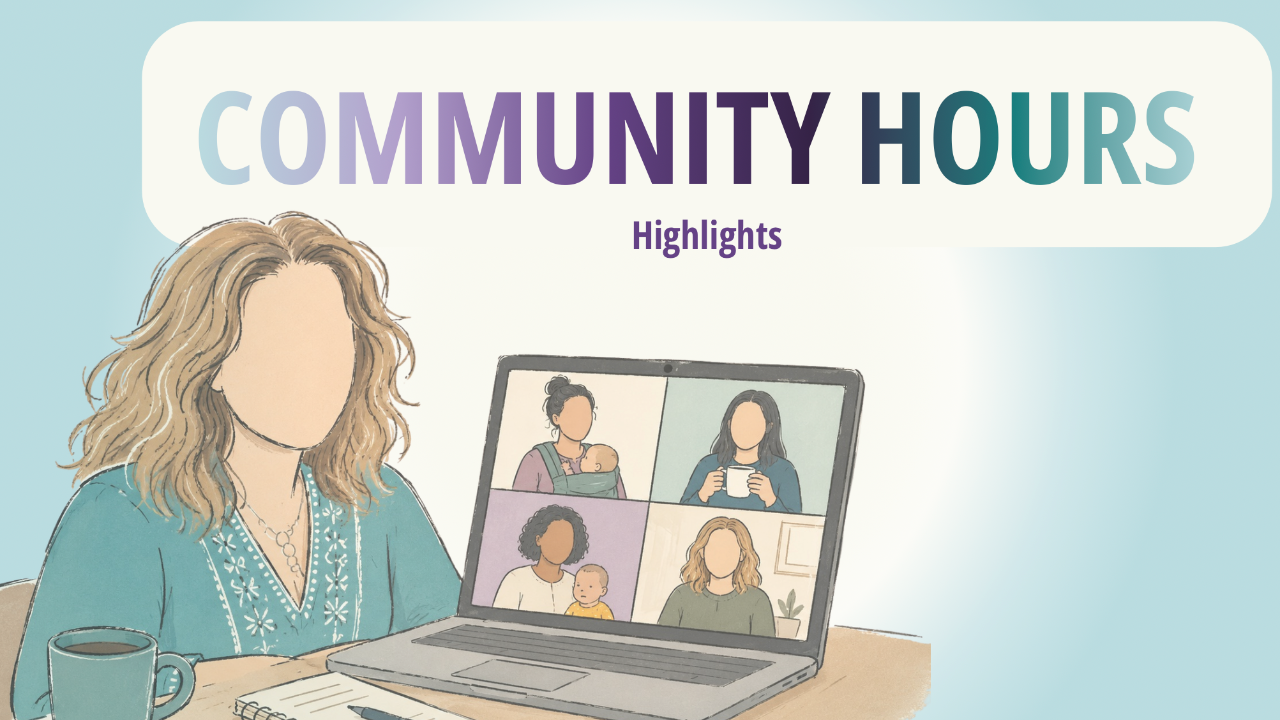
Notes from Community Hours: teaching libraries, hosting events, maintaining cultural humility, and some questions that don't fit in a manual
Thanks to everyone who came to last week’s Community Hours! Joanna hosted our quarterly call, and more than 60 people joined us at some point during the 90 minutes. It’s a drop-in call, so people pop in and out as they can, and we covered a lot.
As promised, I pulled together a round-up from my notes. If you missed the call, you can catch up below. And if you’re still weighing up whether you want to take Foundations, this will give you a pretty good sense of what these free quarterly calls are actually like.
Community Hours is open to babywearing educators and consultants who’ve been through CBWS Foundations. People bring whatever they’ve got: the client from last week, the event on Saturday, the thing that went sideways, the thing that went really well. From “okay, here’s what I’m dealing with, what would you do?” to sharing with a room full of people who absolutely 'get it' that you just booked your first paid consultation!
This round went from hunting down affordable meh dais, to triaging a free event with 32 registrations, to a long stretch about what to do when everyone in the room already has a baby carrier. Oh, and weighted teddy bears came up. So, yeah, normal Community Hours stuff.
• • •
Why are meh dais suddenly so hard to find?
The first question came from an educator getting ready to teach her first basic babywearing class in Santa Fe. The organization she works with is buying her supplies, which is great, and she wants a small teaching collection so families can see and try a few carrier styles.
Her sticking point was the meh dai. She wanted something simple: tie waist only, padded non-wrap shoulders, reasonably priced, available in the US, sturdy enough to survive years of repeat use in classes and eventually a lending library. What she didn't want was to send her office manager stalking resale groups for six matching carriers, which is fair. Or to spend the precious non-profit resources on a highly expensive meh dai that was out of reach for her community anyway.
Turns out that's a harder ask than it used to be. The category has shrunk to practically extinction territory. Some longtime-favorite options are gone, others are a pain or very expensive to buy in the US, and a lot of what gets called a meh dai now is really a half buckle.
Girasol still makes the MySol and WrapMySol in several configurations, so depending on the model, there's a choice between padded or wrap-style shoulders and a tie or buckle waist. The double-tunnel design also lets the panel sit differently as the baby grows.
Little Zen One has a solid guide to the Girasol MySol and WrapMySol and a program specifically for babywearing educators and consultants.
The Beachfront Baby Buckle Meh Dai also got a mention. Not a traditional tie-waist meh dai, but it's light, it handles water, and it might earn a spot in a teaching library in a hot climate or for families who want something they can use in a pool.
Finding a carrier that still exists is only step one. For a teaching library, the questions stack up fast:
- Will it fit across a wide range of bodies?
- Are the straps long enough for different wearers to tie comfortably?
- Does the panel adjust for different ages and sizes of babies?
- How does the fabric hold up after fifty people have handled it?
- Can it be washed - easily?
- Could a family in that community realistically afford this carrier if they fall in love with it?
That last one gets skipped a lot. A gorgeous carrier that fits the educator perfectly isn't automatically the best use of a nonprofit's very limited budget.
The group also talked about going straight to brands, asking for a sample or discount, and being specific about the use and how it will help the brand. Educator discounts are a common part of the conversation when carriers are being bought for demos, classes, or a lending library rather than resale. And if donated or secondhand carriers are part of the plan, our Ethical Baby Carrier Donation Guide covers what's still okay to pass along.
• • •
When 32 people sign up for a casual meetup
Another educator shared that she agreed to help with a free babywearing meetup at a new birth center in New Jersey. Low-key thing. Families bring their carriers, try a few options, get some help.
Then 32 people registered. Most of them bringing a baby, a toddler, or both. Ninety minutes. Two educators. Now what?
Eek. That math doesn't math....
Two people can't run 30 full consultations in an hour and a half, so the group flipped the question. Not "how do we get to everyone," but "what does each person walk out with?"
One good adjustment to the carrier they already own? A chance to try something they'd only seen online? Some sense of what comfort and fit are supposed to feel like? Or just knowing that local babywearing support exists and they're not troubleshooting a wrap alone at 2 am? For a free 90-minute event, these are real potential outcomes.
The practical suggestions that came out of it:
- Ask ahead of time what carriers people own or want help with
- Decide what's in scope before anyone arrives, and set the expectations
- Build a flow so attendees can see where to go and what kind of help is on offer
- Collect email addresses, not just social handles, so follow-up is possible
- Give the event a hard ending, or someone will turn up at minute 85 expecting a full consultation
- Keep the high-attention skills, first-time back carrying being the obvious one, out of a crowded intro event
- Bring a useful range of carriers, not the entire collection
- Have a plan for the person who needs more time than the event can give
We've written before about creating structure and boundaries at babywearing meetups. Free doesn't mean unlimited. Boundaries at a community event are what let two educators help a lot of people and still be standing at the end of it.
About those practice dolls
She was also worried she didn't have enough demonstration dolls.
The advice was refreshingly low-tech. A weighted teddy bear works. A rice bag stuffed inside a newborn sleeper works, and a small bag in the body plus smaller sealed bags down in the feet gets a little more weight and flop out of it. Or, for a more crafty hack, use a regular doll and add weight.
Nobody needs 30 identical dolls lined up like a small unsettling army. (Well, except for events like The Babywearing Weekend, perhaps.) A few practice options help when someone's learning a new skill, but at a community event most families want to use their own baby and their own carrier anyway.
• • •
Who's actually in the room? And what do they need?
One more from the call. An educator is putting together a short babywearing presentation for a community baby shower. The hospital serves a lot of recently immigrated Spanish-speaking families, and she'll have a Spanish-speaking colleague with her, so language wasn't the issue.
She was stuck on not knowing who's in that room and what they need to know about babywearing. Maybe people carry already, maybe they don't, maybe somebody's doing it a way she's never seen. What she didn't want was to stand up and call something incorrect when it's just how someone's family does it, or hand over one narrow set of habits as the whole field. She wants to be respectful.
So the answer was basically: ask first. Be curious. What are people using, what's working, what questions do they have for the next twenty minutes? A presentation built from those answers looks nothing like one built before them.
Even swapping "babywearing" for "carrying your baby on your body" changes how a room responds, and boils it down to function that people can understand.
Unfamiliar and unsafe aren't the same word.
Airway, breathing, circulation = support and security. The baby's age and development. The caregiver's body. All important, and none of it depends on one carrier style or one carrier panel height being the standard.
This overlaps a lot with earlier posts on staying curious as a babywearing educator and answering questions about safety without creating unnecessary fear.
Two educators came up as worth following, and both of them post plenty, so there's a lot to dig into. Antonio Negreiros, known online as Wawa Lifter, shares a steady stream of content. Occupational therapist Busi Musiiwa, who founded Babue Carriers, recently went live on Instagram to talk through her own experience. Both worth a follow.
Nobody knows every carrier, every method, and every reason behind them. That was never the assignment. The skill is noticing the gap and not filling it with a correction.
Whoever's leading the class isn't automatically the person in the room with the most experience carrying a baby. That's fine. It usually makes for a better class. Stay curious.
• • •
And then we started planning 2027
Because ninety minutes apparently is never enough, the call drifted into possible locations for future Babywearing Weekends and HELD gatherings. New York City, Queens, New Jersey, San Diego, Phoenix, Toronto, Victoria, Philadelphia, Chicago, Connecticut, San Diego, Los Angelos, San Antonio, and a few more.
Nothing's decided. A city can look perfect on a map and still be the wrong call without a local host who knows the area, can help find the right space, and is well connected to the educators and allied professionals who'd actually benefit from showing up. More on that later.
• • •
About the calls
Community Hours is just one of the ongoing perks for graduates of CBWS Foundations in Babywearing Education, along with the Graduate Portal and a network of people chewing on the same problems. For anyone who wants it more often than quarterly, the Carry-On Collective runs year-round and meets live a few times or more a month.
Next Community Hours... somebody will bring a question none of us saw coming. Usually happens, and it's loads of fun!