How to Run A Babywearing Meetup: Sustainable Group Support
Apr 28, 2026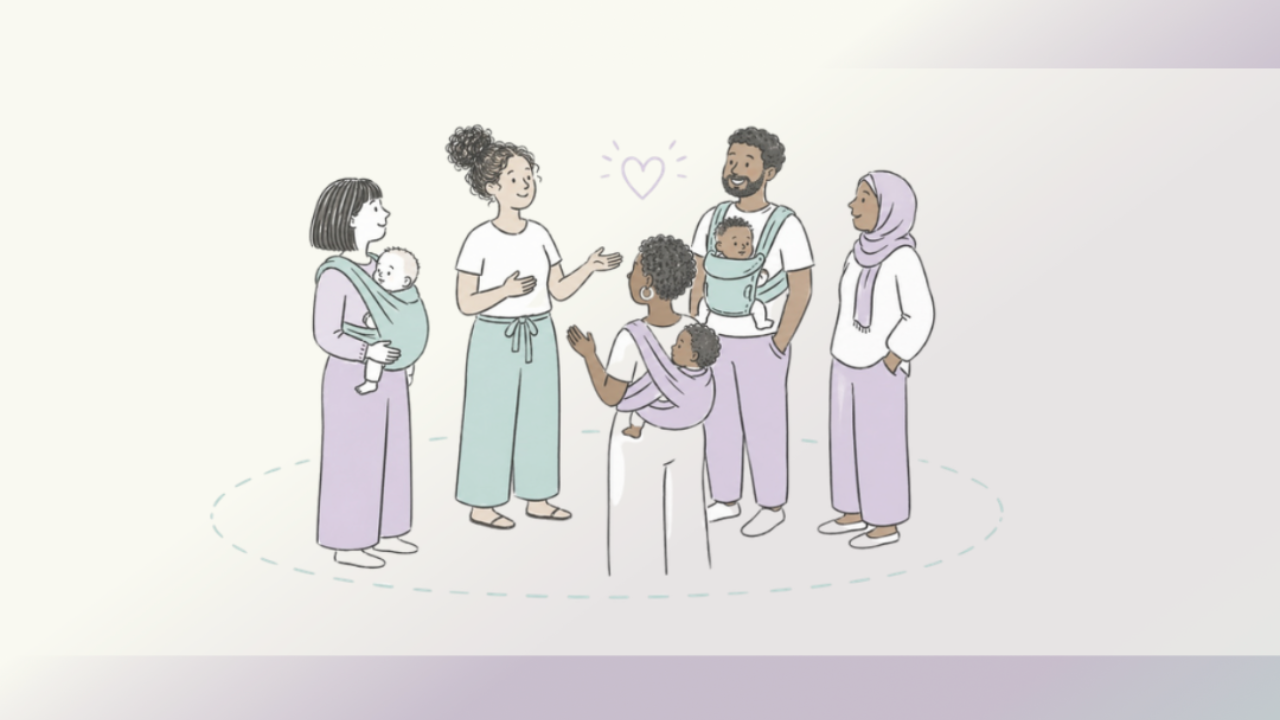
Community babywearing spaces are beautiful. They can also become, very quickly, a lot.
One minute, people are chatting, sharing carriers, passing babies back and forth, and swapping stories about what worked, what did not work, and which carrier is currently living in the backseat of the car.
The next minute, someone arrives with three carriers, someone else needs a fit check, a parent with twins walks in halfway through, a toddler is melting into the grass, and suddenly the “casual meetup” has become a full-service babywearing clinic with no receptionist, no intake form, and no break.
If this has happened to you, you aren't doing it wrong. This is the challenge of babywearing group work, one that every group and meetup will have to address somehow in order to stay sustainable and serve your community in the way you want to.
Babywearing educators often come into this work with a deep desire to help. We want babies comfortable. We want caregivers supported. We want people to feel less alone. We want that moment where someone says, “Oh wow, this actually feels better.”
But wanting to help does not mean every community gathering has to become an unlimited private consultation. Structure matters!
A free community space still needs boundaries.
Boundaries are not the opposite of generosity. They are what make generosity sustainable.
Community First, Education Second
A babywearing meetup is not the same as a babywearing class.
Some of the best babywearing spaces aren't built around perfect teaching demonstrations. They're built around people feeling less alone. Parenting can be isolating, and sometimes what someone needs most isn't a fit check, it's just knowing that someone else also has four carriers and still hasn't figured them out.
Connection matters. Let it be part of what the meetup is for.
That said, if the meetup is community-focused rather than instruction-focused, say that upfront. If individual support time is limited, say that too. People do a lot better when they know what kind of space they're walking into.
There Is No Such Thing as One Quick Question
Okay, sometimes there is. A genuinely quick question does exist.
But usually "quick question" is more like:
- Can you check this carrier I've never used before?
- Actually, can you check all three?
- Can you help me figure out tandem carrying?
- Can you show me back carries?
- Can you tell me why my baby screams every single time I try this one?
That is not one quick question! Some of these might even be difficult to address in one private consultation, much less in a group setting with limited time.
It really helps to think about time and scope before the meetup even starts. Things like:
- "I can help each person with one carrier today."
- "We have time for three individual fit checks."
- "The first half is open community time, the second half is hands-on support."
- "More complex situations might need their own session so we can actually give them the time they need."
Say it out loud without guilt. A parent of twins deserves real support. A caregiver troubleshooting multiple carriers deserves actual time, not five rushed minutes in a park while someone else's toddler is losing it over a juice box. Some situations just need more than a casual meetup can give. Pretending otherwise does both you and the caregivers you're helping a disservice, and can negatively influence your community's perception of what babywearing support can look like.
Your Capacity Matters
Babywearing educators are usually very good at thinking about everyone else's needs. The baby's needs, the caregiver's needs, the group's needs, their own family's needs.
But your capacity must be a part of the equation too.
Time is finite. Childcare is hard to come by. Your energy has limits and it will show when you've ignored your needs for too long.
If a free meetup means an hour drive each way, loading up carriers, managing your own kid, teaching multiple families, and answering follow-up messages afterward, that's not "just a meetup." That's a significant chunk of your life! Not to mention the time you probably spend marketing, inventorying carriers, and maybe even finding, training, and managing other volunteers.
Something has to give. Maybe that means choosing a closer location or running free meetups less frequently and adding a paid option for deeper support. Maybe it means partnering with a local organization that can cover a vendor fee while keeping the event free for families.
There's no single right answer.
But pretending your time is "free" is not a sustainable plan.
It's Okay to Change the Format
If something felt chaotic or unsustainable after your first meetup, change it.
The first few versions of anything provide information. They tell you what worked, what didn't, what people actually needed, and what you can realistically accomplish. You're not locked into whatever the first session looked like.
You can just tell your group:
"I'm going to tweak the format a little based on how the first one went."
People appreciate that kind of honesty, and it shows them that you care about giving them a good experience.
You Do Not Have to Know Everything
Seriously. You don't.
If a parent comes in wanting tandem support and that's outside your wheelhouse, you shouldn't fake it (I repeat: DO NOT fake it). Just ask what they're actually trying to do. Wear both babies at once, or mostly get one settled while managing the other? What carriers do they already have? Would it help to connect them with someone who has more twin experience?
That's it. You don't have to have the answer. You just have to be willing to ask the right questions and be honest about what you know and don't know.
Sometimes the most helpful thing you can do is pick up the phone and call a colleague, or sit in on a virtual consultation so you can better support the family afterward.
No single educator has to be the entire village. Community goes both ways.
At the end of the day, babywearing meetups are not meant to prove how much you can give, how many people you can help, or how much you can hold at once. When there is clarity, structure, and respect for everyone’s time and capacity, these spaces become more meaningful because of it. And that’s what allows them to last, grow, and truly support the communities they’re built for.