Your baby was born expecting to be carried
Sep 19, 2026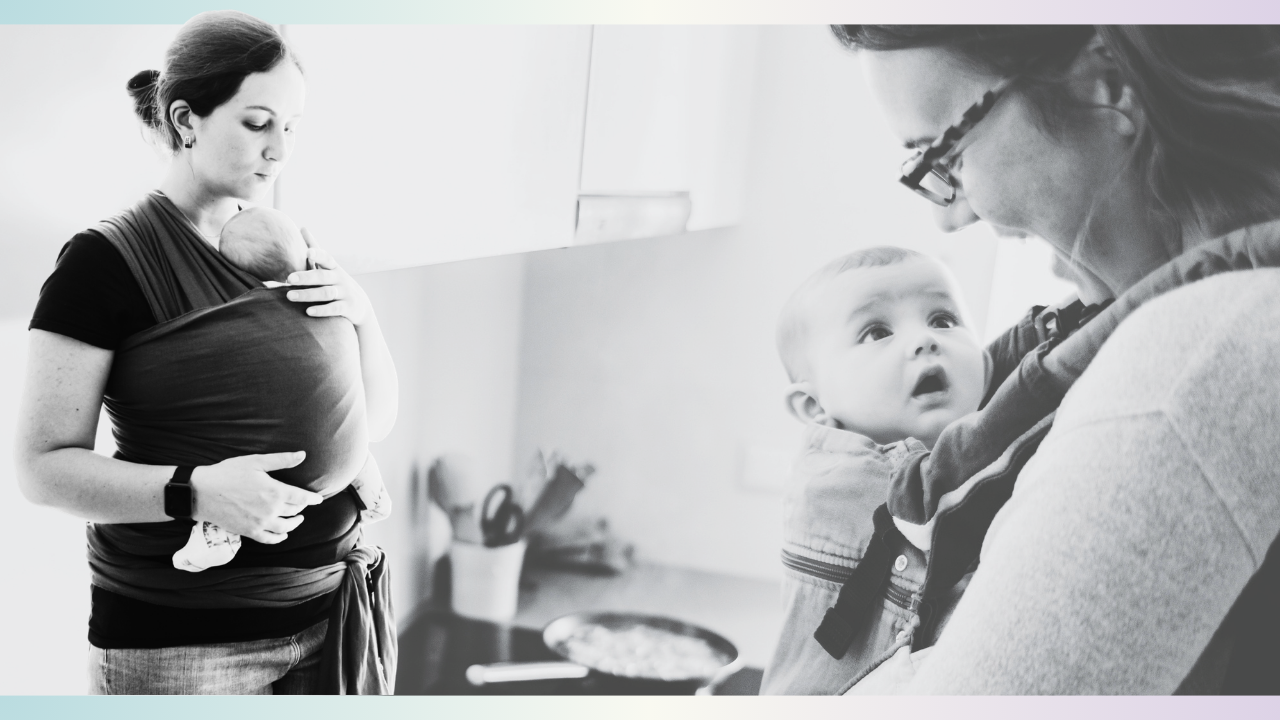
Somewhere along the way, maybe from a relative or a comment online, you might have picked up the idea that carrying your baby a lot is a bit of a trend, or will spoil your baby. I want to share something reassuring from the science instead. A 2020 research review by Bernadett Berecz and her colleagues gathered the evidence and put forward a simple idea: your baby was born expecting to be carried, and holding them close is one of the most normal things you can do.
•••
Here's what I love. Your baby isn't just ‘along for the ride.’ They come pre-loaded with little reflexes that help them take part in the holding. Lift your baby up and watch their legs come up into a tucked-up, squatted shape, sometimes referred to as the ‘spread squat position.’ That's them getting ready to settle onto your hip. When they feel like they're slipping, their arms fly out and then pull back in, a built-in way to make sure they grab hold again. Their hands grip, and that grip actually gets stronger while they feed. None of this is something you have to teach to your baby. It's already in there, waiting for you to discover and embrace.
There's a reason it feels so natural for both of you, too. As you carry your baby and move around, their body tension tends to ease, and they calm down some, with a slower heart rate and a stillness researchers, such as Esposito, call the transport response. It's a built-in piece of wiring that kept babies quiet and safe when their caregiver needed to move. And close contact releases oxytocin in you and in your baby at the same time. That's the hormone that lowers stress, lowers your blood pressure, and helps the warm, bonded feeling grow between you. So when carrying feels good, that's not your imagination. It's chemistry doing exactly what it evolved to do.
•••
You might still worry about spoiling your little one. I'd love for you to just let that one go. The review found that responding to your baby and keeping them close is linked with better long-term outcomes, and that a lot of unanswered crying is the thing to really be concerned about, not a lot of holding. Meeting your baby's need to be near you is you doing your job beautifully.
•••
Carrying gives your baby a front-row seat to the world, too. Up on your hip, they're at your height, close to your face, hearing your voice clearly and watching how people talk and take turns. Researchers connect that closeness to how babies learn language and read emotion. Every trip to the kitchen becomes a little lesson, with you as the guide.
If it helps to zoom out, the researchers trace carrying back an astonishingly long way. Our ancestors have carried their young for millions of years, and the deep predisposition goes back around fifty-five million years, to the earliest primates whose babies clung to their fur. Your great-great-uncountable-great-grandmothers all did a version of what you're doing today. You're part of a very long, very tender chain. A fun book to check out is Timothy Taylor's The Artificial Ape.
•••
So carry your baby when it feels right, in arms and in a sling, and trust that the two of you already know the steps.
•••
This is what your baby was preparing for all along.
•••
•••
References
Berecz, B., Cyrille, M., Casselbrant, U., Oleksak, S., & Norholt, H. (2020). “Carrying Human Infants: An Evolutionary Heritage.” Infant Behavior and Development, 60.
Esposito, G., et al. (2013). “Infant Calming Responses during Maternal Carrying in Humans and Mice.” Current Biology, 23(9), 739–745. DOI: 10.1016/j.cub.2013.03.041.