Carrying Isn't a Bonus. It's the Baseline.
Sep 29, 2026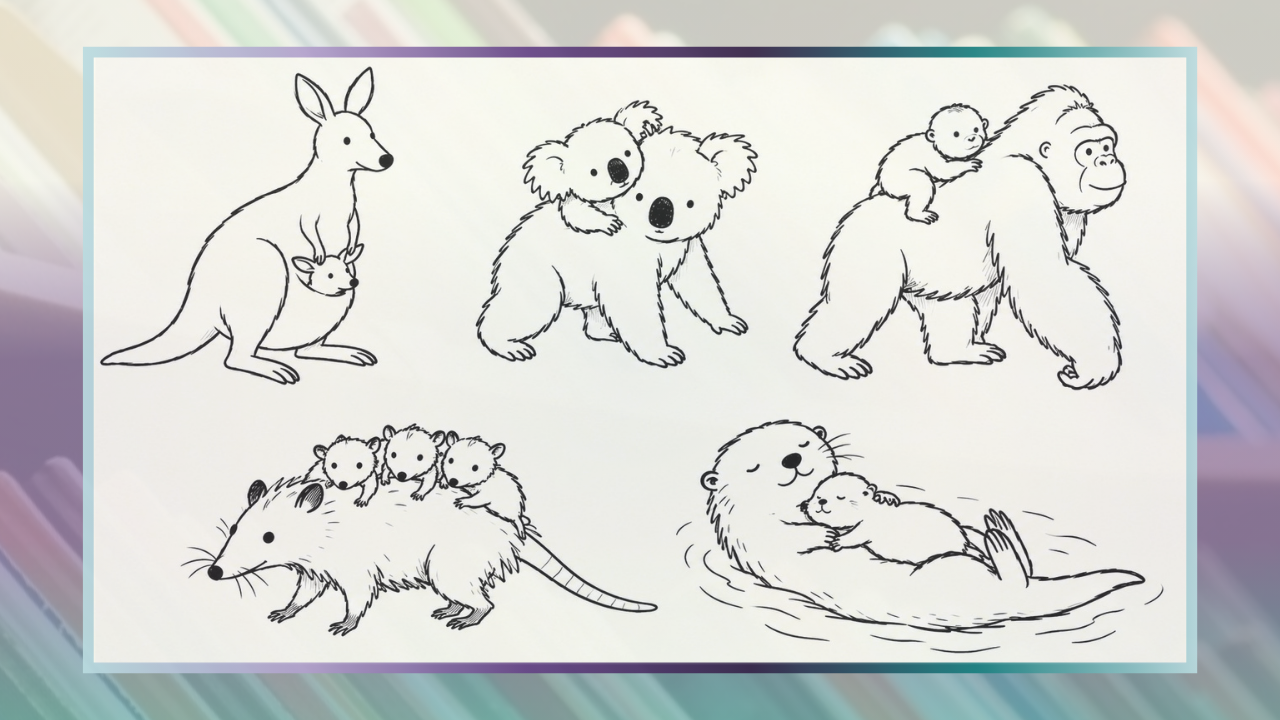
When you’re teaching, you likely build your babywearing patter around benefits. Carrying helps with bonding. Carrying calms crying. Carrying supports healthy hips. All true, and all handy when a parent is wavering. And if you’ve taken Foundations, you may already know what I am about to share, but a review by Berecz and her colleagues, published in Infant Behavior and Development in 2020, gently asks us to shift our focus. And I want to share that with you. Their case is that carrying is the baseline your baby was built for, so the strongest thing you can tell a parent isn't that carrying adds something. It's that carrying is simply normal care.
I cover this topic in more detail, but this paper is a nice way to share the whole picture with others. So let me walk you through the parts I think might change how you frame things in your work.
•••
Start with the deep history, because it can be a wonderful hook for some families. Clinging has evolved separately five to seven times among primates, and here's the striking bit: once it appears in a lineage, it never disappears. That persistence is the whole argument in sum. Carrying costs a mother energy and shrinks her range, and yet, evolution doesn't keep expensive habits around unless they pay for themselves. So when a parent asks, “Is all this holding really necessary?” You can answer, “Biology already ran the experiment, over millions of years, and kept the result.”
•••
For our own lineage, the story changes with us standing up. When our ancestors moved onto two feet, they lost the flat back a baby could ride on. The authors suggest infants then shifted from the back to the front, and then to the side, onto the hip. The modern hip carry you demonstrate every week has its logic sitting right there in our anatomy's past. There's a lovely detail in Australopithecus afarensis: the juveniles had a mobile big toe for gripping a parent, and they lost that mobility as they grew into full-time walkers.
By the time we reach Homo erectus, roughly two million years ago, several threads come together in my mind, as gold for teaching. Body hair changed, so babies could no longer grip fur. At the same time, women's bodies carried more fat, and the authors point out that the hip became a soft, stable shelf to seat a baby on. Brains were growing fast, so newborns arrived less finished and more dependent. And this is the moment the researchers, following Taylor and Falk, put forward as the likely birth of the sling, probably invented by Homo erectus mothers.
•••
This is a great place to bring in Timothy Taylor's book, The Artificial Ape, which the paper leans on. I found his book a fun, easy read. Taylor thinks the baby sling may have been one of the earliest pieces of technology we ever made, possibly even earlier than stone tools, and that it was likely a mother reaching for a way to hold her baby who first turned to technology at all. His argument is that carrying our babies this way is part of what made us human, since slings freed our hands, let us keep our fast-growing but helpless newborns close and alive, and in effect turned us into artificial marsupials. Two phrases worth adding to your teaching toolkit might just be: the sling is what made us human, and slings made humans artificial marsupials.
•••
Now the part I'd lean on hardest with new parents: reflexes. The paper frames the baby as a reflexively active participant, not a passive parcel, and gives you the vocabulary to explain it. The tonic labyrinthine reflex helps a baby practice head and neck control as they're held off center. The palmar grasp helps them hold on, and it gets stronger during suckling, which hints at how feeding and clinging were once braided together. The Moro reflex, which Moro himself called the embracing reflex, brings a baby's arms back in to regain their hold when they feel a loss of support, and it quiets once the baby is actually gripping. The stepping reflex works on the body as a clinging adjustment. Then there's Kirkilionis's clinging response, the spread squat a baby makes when you lift them, dropping neatly into the physiological flexion of around 110 to 120 degrees that lets them fit the hip. When you name these in a class or during a consultation, carrying stops looking like something we impose on a baby and starts looking like an experience the baby anticipated and is eager to help with as well.
•••
The developmental payoffs give you more to work with. Held on the side or hip, a baby sits at adult height, hears speech clearly, reads faces, and joins social life as a participant. The authors link this vantage point to language taking off. They also discuss the left-cradling bias, a finding dating back to Salk: most women hold babies on the left, which keeps the baby near the right hemisphere's emotional processing and frees the right hand. There's even a thread connecting that to the rise of right-handedness.
And then, the physiology closes the loop. Carrying triggers the transport response (Esposito), a calm state with a slower heart rate and less bodily movement that helps quiet baby. Gentle touch releases oxytocin in both bodies, lowering cortisol and blood pressure. The authors also fold in epigenetics (Moore), including work showing that high distress paired with low contact tracks with a younger epigenetic age, a sign of stress rather than something good. That's a serious, careful point to note, and it's why the paper flags crying as a real risk factor for abuse, and babywearing as a tool that can help families under strain.
•••
So here's what I'd want you to take away: You don't have to sell carrying as an upgrade. You get to describe it as coming home to something a baby has expected for fifty-five million years.
•••
Lead with the norm, teach the reflexes, and let the parent see their baby as the skilled little partner they already are.
•••
•••
References
Berecz, B., Cyrille, M., Casselbrant, U., Oleksak, S., & Norholt, H. (2020). Carrying human infants – An evolutionary heritage. Infant Behavior and Development, 60, 101460. https://doi.org/10.1016/j.infbeh.2020.101460
Esposito, G., Yoshida, S., Ohnishi, R., Tsuneoka, Y., Rostagno, M. del C., ... Kuroda, K. O. (2013). Infant calming responses during maternal carrying in humans and mice. Current Biology, 23(9), 739–745. https://doi.org/10.1016/j.cub.2013.03.041
Falk, D. (2009). Finding our tongues: Mothers, infants, and the origins of language. New York, NY: Basic Books.
Kirkilionis, E. (1992). Carrying the infant sitting on the mother's hip: A special adaptation of the clinging young. Anthropologischer Anzeiger, 96, 395–415.
Moore, S. R., McEwen, L. M., Quirt, J., Morin, A., Mah, S. M., Barr, R. G., ... Kobor, M. S. (2017). Epigenetic correlates of neonatal contact in humans. Development and Psychopathology, 29(5), 1517–1538. https://doi.org/10.1017/S0954579417001213
Salk, L. (1960). The effects of the normal heartbeat sound on the behaviour of the new-born infant: Implications for mental health. World Mental Health, 12, 168–175.
Taylor, T. (2010). The artificial ape: How technology changed the course of human evolution. New York: Palgrave Macmillan.