When YouTube and “Looks Good” Aren’t Enough
May 19, 2026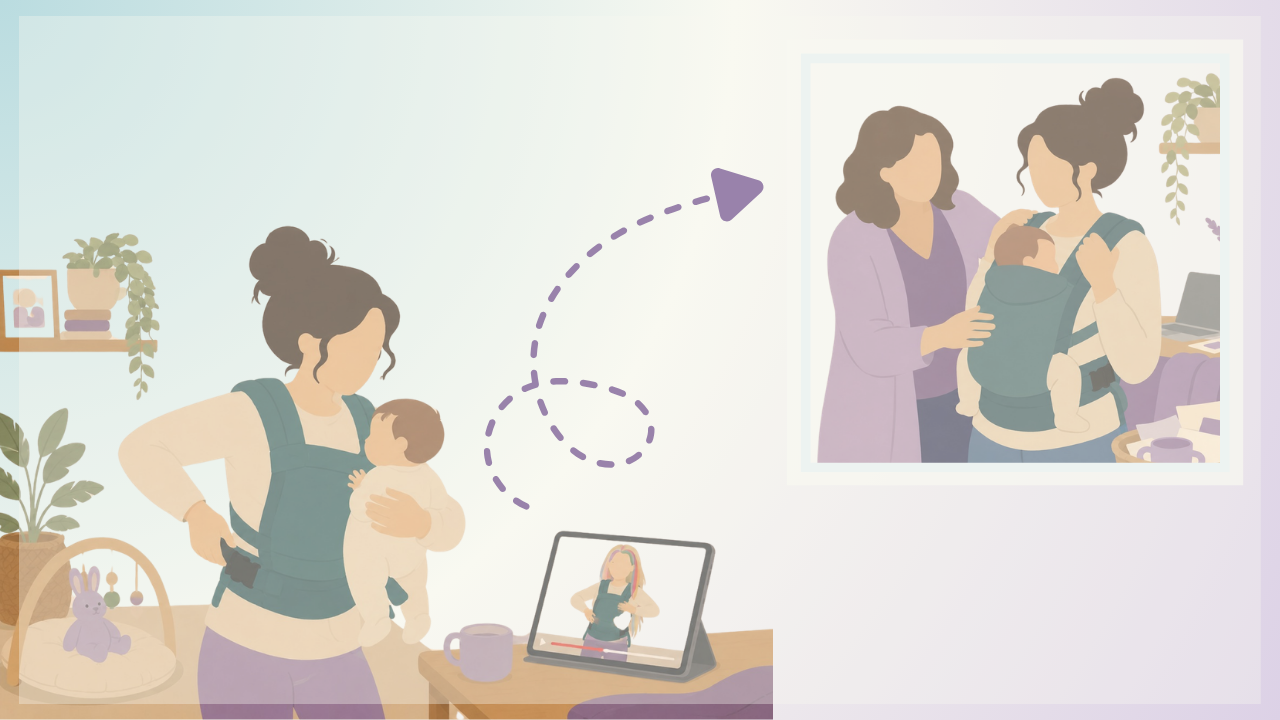
Niala had done what so many new parents do.
- She had prepared.
- She had asked questions.
- She had bought a baby carrier while she was still pregnant. A friend had lent her a ‘long, soft piece of fabric’ - which turned out to be a stretchy wrap, by the way.
- She had watched videos.
- She had asked her doula.
- She had read the online Reddit and Facebook groups.
- She had searched online.
And still, 19 days into life with her baby girl, things felt harder than they needed to feel.
Her baby was healthy. Birth had gone well. Breastfeeding was going okay. On paper, everything was fine.
But real life doesn’t happen on paper.
Real life was a baby who cried the second Niala put her down. A baby who didn’t seem to love the car seat or the stroller. A baby who wanted to be close, while Niala was starting to feel the very real need to move around, get out of the house, pick up groceries, see a friend, and feel like a person in the world again.
The carrier she had bought didn’t ‘feel right.’ The stretchy wrap had almost worked once, but not quite. The videos helped a little, but not enough. Her doula had reassured her that things looked fine, but Niala still felt uncomfortable, unsure, and a little stuck.
This is often the moment when people reach out.
Because they’ve already tried a lot, and they’re tired of trying to piece together general information for a very specific baby, body, carrier, and day.
And underneath all of that was something harder to explain. Niala was not only trying to figure out her carriers. She was trying to figure out whether her concerns were real.
Everywhere she turned, she seemed to get a partial answer. The videos showed a baby who slid neatly into place, and the product pages made the carriers look effortless. Her doula reassured her with a shake of her head, ‘This is good enough.’ Online groups had plenty to say, but not all of it felt kind, clear, and, maybe most importantly, relevant.
And the more she asked, the more she felt like people were gently, and sometimes not so gently, telling her she was “making a mountain out of a mole hill.”
That feeling was wearing on her.
During Maternal Mental Health Month, I think it is worth calling attention to this:
New parents don’t need someone to calm them down by minimizing their concerns. They need someone to take the concern seriously enough to help them resolve it.
Because there is a significant difference between reassurance and being dismissed.
Niala wasn’t looking for drama. She was looking for peace. She wanted someone to answer her actual questions, with her actual baby, her actual carrier, and her actual body in mind.
That was a large part of the urgency.
The online communities were not easing her stress. They were adding to it. Instead of helping her feel more capable, they left her second-guessing herself even more.
- Was the carrier wrong?
- Was she wrong?
- Was her baby uncomfortable?
- Was she overreacting?
- Was everyone else finding this easier?
Why is her baby crying? And, is this an issue with her?
By the time she reached out to me, she didn’t need another thread to read. She needed a person. A person who would listen and help. End of story.
At first, Niala wasn’t sure she wanted to pay for help with carriers she was not even sure she liked. That made complete sense to me. I don’t think every parent needs a private consultation first.
I pointed her toward my lower-cost options too: a Babywearing 101-style class for learning the basics, a troubleshooting-focused class for people who already have a carrier and need help making it work. And I also shared the local babywearing group and the manufacturer’s own website. Manufacturers should support their customers in using their products. Those are all good options.
But, you see, Niala needed something different.
She wanted help now, or at the latest, the next day. She wanted someone to listen and then look at her actual situation and say,
“Here is what I am seeing. Here is what your baby is doing. Here is why this might feel uncomfortable. Here is what we can try next.”
She wanted context.
She wanted to know whether what she was experiencing was normal, whether she was doing something wrong, and whether there was a way to make leaving the house feel less like a full-body emergency.
Her goals weren’t “learn to use my carriers.”
They were:
- Trust herself and the carriers.
- Understand her baby.
- Go to the grocery store and use a carrier so the baby doesn't cry.
- Visit a friend without needing a stroller that would take up half the house.
- Take the baby in and out of the carrier without having to start over every time.
- Feel secure enough to make small adjustments and keep going.
These goals often get lost when we talk about babywearing education as if it is only about tightening and positioning.
For a new parent, a baby carrier can be the difference between feeling trapped on the couch and being able to make lunch, listening to a baby cry in the stroller and taking a slow walk around the block, or feeling like every errand is impossible and realizing, “Oh. We can do this.”
Niala had already found plenty of information and some reassurance, but what she needed was specific help sorting through her situation with her baby.
She was tired of the research, the “best carrier” lists that felt more like sales pages, the online groups where the answers were often not useful, and she was tired of conflicting opinions about which carriers were good, which were bad, and what she “should” be doing.
She used TikTok and IG, but not as places where she wanted to learn. Sometimes, convenience is the thing that makes support possible.
In the end, Niala decided the consultation was worth it. As an investment in a smoother day, her confidence and even her baby's stress levels.
It became an investment in being able to leave the house with a little more ease.
And that’s why one-to-one babywearing support matters.
The right support at the right moment doesn’t simply answer the question, “Is this carrier on correctly?”
It asks:
- What are your goals?
- What feels hard right now?
- What does your baby seem to need?
- What does your body need?
- What kind of day are we trying to make possible?
That’s where we can make an impact.
If you want to help others in the “I watched the videos, and I still don’t feel sure” stage, you have options. You are in the right spot. If you want to offer a babywearing 101-style class, a troubleshooting class, and/or host a free local babywearing group, I invite you to also consider the person who needs help today, right now, because your support may be their most direct path to confidence.