From Toys to Togetherness: Rethinking What “Play” Really Is for Babies
Jul 14, 2026
You’re standing at the kitchen counter putting away groceries. Your baby watches from a carrier, a high chair, or a safe spot on the floor. You lift an apple from the bag. Your baby tracks it with their eyes. The paper crinkles. A cabinet door opens and closes. You say, “These go in the fridge,” and your baby kicks, reaches, squeals, or simply watches.
An adult may describe this as the time before play begins. First you finish the groceries, then you get down on the floor and bring out the toys.
I’m no longer convinced that babies experience such a clear boundary.
From your baby’s perspective, putting away the groceries already offers movement, sound, language, texture, repetition, anticipation, and connection with you. The ordinary world is full of material to study. Your baby doesn’t know that the bright plastic object in the toy basket has been labeled “educational,” while the wooden spoon, passing bus, family conversation, or rhythm of sweeping the floor has been labeled “everyday life.”
That distinction belongs to adults.
How did play become something adults provide?
Many families are surrounded by messages suggesting that babies need frequent entertainment and a steady supply of products to support their development. Toys flash, sing, count, name colors, and respond to every push of a button. Packaging promises learning, stimulation, readiness, and an early advantage.
I understand why these promises are persuasive. Caring for a baby comes with an enormous sense of responsibility. When someone says a product will help your baby learn, buying it can feel like an act of love.
The research gives us good reason to question whether a toy’s ability to produce more sound, light, and information creates a richer experience for a baby.
In one small home-based study, 26 families played with electronic toys, traditional toys, and books with infants aged 10 to 16 months. During electronic-toy play, adults spoke fewer words, responded less often to their babies, and had fewer conversational turns. Babies also vocalized less during electronic-toy play than during book sharing. The researchers noted that the electronic toys appeared to take over some of the talking that would otherwise have happened between caregiver and child.
That study was small, and the families weren’t especially diverse. I wouldn’t use it to declare every electronic toy harmful or to make parents feel guilty about what’s already in their homes. I would use it to ask a better question:
What does this toy make possible between this baby and this caregiver?
Some toys leave space for a baby to initiate, experiment, wait, look toward you, make a sound, and receive a response. Other toys fill that space quickly. They produce the sound, direct the sequence, and decide what happens next.
The word educational on a box tells us very little about the quality of the experience taking place around it.
What happens when there are fewer toys?
The idea that more options create more learning feels intuitive. Research on infants and toddlers suggests that an abundance of options can sometimes fragment attention.
In a study of 36 toddlers between 18 and 30 months, each child played in two conditions, one with four toys and another with 16. With four toys available, the toddlers played with individual toys for longer and used them in a greater variety of ways. The researchers described the smaller selection as supporting more sustained and varied exploration.
Because this study involved toddlers rather than young babies, I wouldn’t apply its conclusions directly to every infant.
A second study brings the question closer to babyhood. Researchers observed 81 mother-infant pairs playing when the babies were 12 months old. Some pairs received five toys and others received 12. With fewer toys, the episodes of shared attention lasted longer and were more likely to become coordinated. The babies showed awareness that their mothers were attending to the same object through looking, vocalizing, or taking turns. The researchers also found longer shared-attention episodes with toys such as stacking rings, which allowed pieces to be arranged and explored.
There isn’t a scientifically perfect number of toys for your living room. Five isn’t a magical developmental threshold, and the research doesn’t require a minimalist home.
What I take from these studies is that the visual and attentional environment shapes play. When every object competes for notice, a baby may move rapidly from one thing to another. When fewer things are available, the baby and caregiver have more time to settle into an experience together.
A cup can be turned, mouthed, dropped, rolled, nested, filled, emptied, offered to you, reclaimed, and dropped again. A baby may return to the same small discovery many times because repetition is part of how babies investigate.
Novelty attracts attention. Familiarity gives babies room to deepen an experience.
Your attention becomes part of what the baby is exploring
Shared play doesn’t require you to direct every moment.
A particularly interesting study used head-mounted eye trackers to record where one-year-old babies and their parents looked during play. When a parent attended to an object the baby was already examining, the baby tended to continue looking at it for longer. The adult’s attention appeared to help sustain the baby’s attention.
I find the direction of that interaction important. The parent followed the baby’s focus. The baby had already found something interesting, and the parent joined them there.
This can happen with a toy, although toys hold no monopoly on shared attention.
Your baby hears the dog bark and turns toward the window. You pause and look too.
Your baby reaches toward the clean washcloths while you fold laundry. You offer one.
Your baby watches the wheels on a passing stroller. You say, “You saw those wheels.”
Your baby bangs a spoon against the high-chair tray. You wait for the pause and tap the rhythm back.
These moments may seem too ordinary to count as enrichment activities. Yet they contain many of the qualities developmental researchers look for in early interaction: attention, timing, responsiveness, repetition, turn-taking, movement, sensory information, and shared meaning.
Shared focus can be quiet. A glance, a pause, or a change in your facial expression may be enough to tell your baby, “I see what you see.”
A wider cultural view of how children learn
The expectation that adults should create a separate, child-centered world for learning isn’t universal.
Cross-cultural research describes many communities in which young children have broad access to family work, social gatherings, community activities, and people of different ages. Children learn partly by watching what others do and gradually participating according to their abilities.
In one comparative study, researchers observed two- and three-year-olds from two middle-class European American communities, an Efe community in the Democratic Republic of Congo, and an Indigenous Maya community in Guatemala. The children in the two American communities had less frequent access to adult work and spent more time in activities created specifically for children. Efe and San Pedro children were more often present around productive adult activity, where they could watch, imitate, and sometimes contribute.
Psychologist Barbara Rogoff uses the phrase Learning by Observing and Pitching In to describe an approach found especially often in Indigenous-heritage communities of the Americas. Children are included in ongoing family and community endeavors, observe with close attention, and gradually take on meaningful roles with support from more experienced people.
Suzanne Gaskins’ research with Yucatec Maya families also asks us to understand play, work, learning, and social life within their cultural setting. Her observations included children from infancy through adolescence and described a daily life organized around adult work, children’s access to what was happening around them, and confidence in children’s own motivation to observe and participate.
I want to handle this scholarship with care. Families and cultures aren’t interchangeable, and Indigenous practices shouldn’t become another parenting trend removed from their history and community meaning. I also don’t want to romanticize daily work. Families may have limited time, unsafe workplaces, stressful commutes, or tasks that simply can’t include a baby.
What this research offers is a wider field of possibility.
Child development doesn’t depend on every experience being designed specifically for children. Babies and young children can learn while included in the meaningful life of their families. Maybe this awareness can take some pressure off families.
So, can watching you chop vegetables really be play?
I’m comfortable calling ordinary participation a form of play when the experience gives a baby room to attend, explore, communicate, move, and connect.
A baby watching you prepare food is seeing repeated actions and their consequences. Whole vegetables become pieces. Objects move between containers. Water changes how things look and feel. Your hands grasp, release, turn, and press. Your voice rises and falls as you talk to someone else or describe a small part of what you’re doing.
The baby may also be learning something harder to measure: how a household moves, how people coordinate, how conversations begin, how pauses work, and what happens next in a familiar routine.
Naturally, participation has to fit the baby’s age, state, and safety needs. A baby can watch chopping from a protected position, such as babywearing, rather than touching sharp tools or hot food. An infant can hold a safe spoon while you stir, especially if you're using a ring sling or hip carry. A mobile baby might move washcloths from one basket to another. A toddler can carry an unbreakable cup to the table.
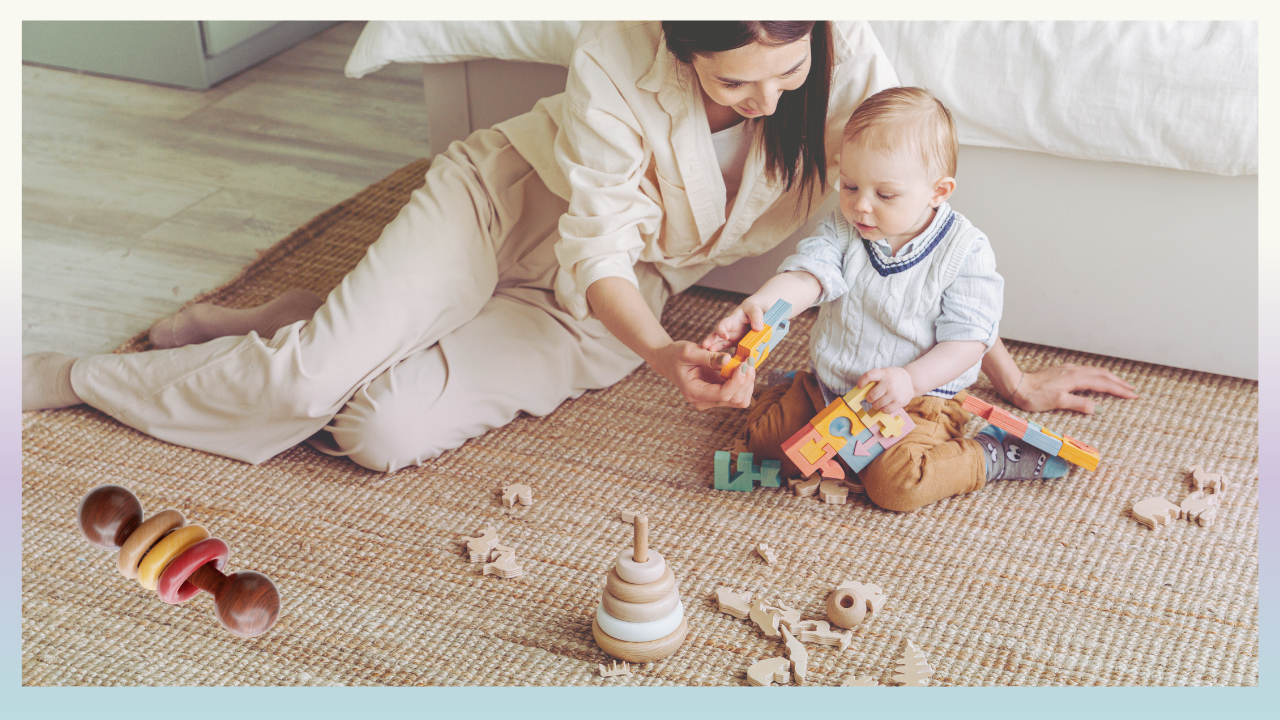
Participation can begin with presence.
A newborn may participate by feeling the rhythm of your body while you walk, listening to voices at the store, or watching light shift across the wall while you fold clothes. An older baby may reach for, imitate, offer objects, make sounds, and begin to anticipate familiar sequences.
A baby carrier can support this kind of inclusion when it’s appropriate for the task. The baby feels your movements and responds by engaging their muscles. And gains a view of your social world while you retain the ability to respond to their cues. Of course, not all activities are appropriate while babywearing, including cooking near open flames, using chemicals, operating machinery, or handling or swinging sharp objects; these require a separate safe space.
The goal is thoughtful access, shaped around the actual baby and environment.
Babies don’t need a full-time activities director
Parents can hear a message about interaction and turn it into another exhausting standard: talk constantly, respond perfectly, transform every chore into a lesson, and make every waking minute developmentally valuable.
I don’t want to add that pressure.
Babies also need pauses. They look away. They rest. They repeat movements privately. They spend time examining their hands, the edge of a blanket, or a patch of sunlight without adult narration. Independent exploration gives babies opportunities to initiate and discover at their own pace.
Your role can shift throughout the day. Sometimes you’re closely engaged. Sometimes you’re nearby and available. Sometimes the baby watches while you speak with another adult. Sometimes the baby becomes absorbed in something, and you let the moment unfold.
The American Academy of Pediatrics describes play as an important context for relationships, exploration, movement, language, and social-emotional development. Its guidance also emphasizes simple, hands-on materials and caregiver interaction over toys that attempt to perform the learning for the child.
No caregiver can be continually responsive, entertaining, and emotionally available. Babies grow within real relationships, which include missed cues, interruptions, reconnection, and ordinary days.
Togetherness doesn’t require constant entertainment.
What this means for educators
When I talk with educators about play, I’d like the conversation to move beyond recommending products or prescribing a set number of minutes on the floor.
I’d begin by asking what already happens in the family’s day.
Where does the baby spend time?
What does the baby enjoy watching?
Which household routines feel calm enough for some shared attention?
Which toys invite the baby to initiate?
Which toys seem to dominate the interaction?
How does the caregiver know when the baby wants engagement, a pause, movement, or rest?
This approach gives educators a way to support development without suggesting that families need more money, more equipment, more floor space, or more free time.
A caregiver who says, “I don’t have enough time to play with my baby,” may be imagining play as a separate, adult-led session that requires preparation and toys. An educator can help that caregiver notice the play already emerging during carrier use and changing, bath time, dressing, laundry, feeding, walking, waiting for the bus, visiting relatives, or simply putting groceries away.
That conversation can also honor family culture. One family may value face-to-face songs and games. Another may include babies in large, multigenerational gatherings. Another may spend much of the day outside. Another may have a quieter home where a baby watches one caregiver work.
The educator’s task is to notice the developmental opportunities within that family’s life and help make them more accessible, responsive, and safe.
Two experiments to try at home or in a learning space
Try a toy edit
Choose a smaller group of toys to leave available for several days. You might put away half, or select four to six varied objects and store the rest temporarily.
There’s no need to buy a new toy-storage system or create a picture-perfect room. A box in a closet works.
Then observe:
Does your baby stay with an object longer?
Do they return to it later?
Do they discover additional ways to use it?
Do they look toward you or bring the object to you more often?
Does the room feel calmer for you?
You can rotate toys as interests change. The purpose is observation, rather than proving that fewer toys will produce a particular kind of child.
Invite your baby into one daily task
Choose one thing you already do and ask:
How can my baby participate in this experience instead of waiting for me to finish?
Participation may mean watching from nearby, hearing you describe one or two actions, holding a safe object connected to the task, copying a movement, handing something to you, or simply moving through the day at your level in a carrier.
You don’t have to turn sweeping into a lesson on physics or laundry into a vocabulary drill. Let your baby see what you’re doing. Follow what captures their attention. Respond when they invite you in.
The world is already interesting
Babies arrive ready to study a world that is moving, sounding, changing, and responding around them.
A toy can become part of that world. It may offer delight, comfort, experimentation, and a bridge between you and your baby. Its developmental value grows from what the baby can do with it and what can happen around it.
The deepest learning may emerge from a small object explored for the twentieth time, a shared glance over a wooden spoon, the rhythm of your steps, or the familiar sequence of putting groceries away.
I’d like families to feel less pressure to construct a miniature world filled with constant stimulation. They can begin by welcoming their baby into the life already happening around them.
The toys may become fewer and quieter.
The relationship becomes easier and more responsive.
Research behind this article
Dauch, C., Imwalle, M., Ocasio, B., & Metz, A. E. (2018). “The influence of the number of toys in the environment on toddlers’ play.” Infant Behavior and Development, 50, 78–87. doi:10.1016/j.infbeh.2017.11.005.
Koşkulu, S., Küntay, A. C., Liszkowski, U., & Uzundağ, B. A. (2021). “Number and type of toys affect joint attention of mothers and infants.” Infant Behavior and Development, 64, 101589. doi:10.1016/j.infbeh.2021.101589.
Morelli, G. A., Rogoff, B., & Angelillo, C. (2003). “Cultural variation in young children’s access to work or involvement in specialised child-focused activities.” International Journal of Behavioral Development, 27(3), 264–274. doi:10.1080/01650250244000335.
Rogoff, B. (2014). “Learning by Observing and Pitching In to Family and Community Endeavors: An Orientation.” Human Development, 57, 69–81. doi:10.1159/000356757.
Sosa, A. V. (2016). “Association of the Type of Toy Used During Play With the Quantity and Quality of Parent-Infant Communication.” JAMA Pediatrics, 170(2), 132–137. doi:10.1001/jamapediatrics.2015.3753.
Yu, C., & Smith, L. B. (2016). “The Social Origins of Sustained Attention in One-Year-Old Human Infants.” Current Biology, 26(9), 1235–1240. doi:10.1016/j.cub.2016.03.026.