When the World Gets Loud: Babywearing Through Sensory Overwhelm
Jun 30, 2026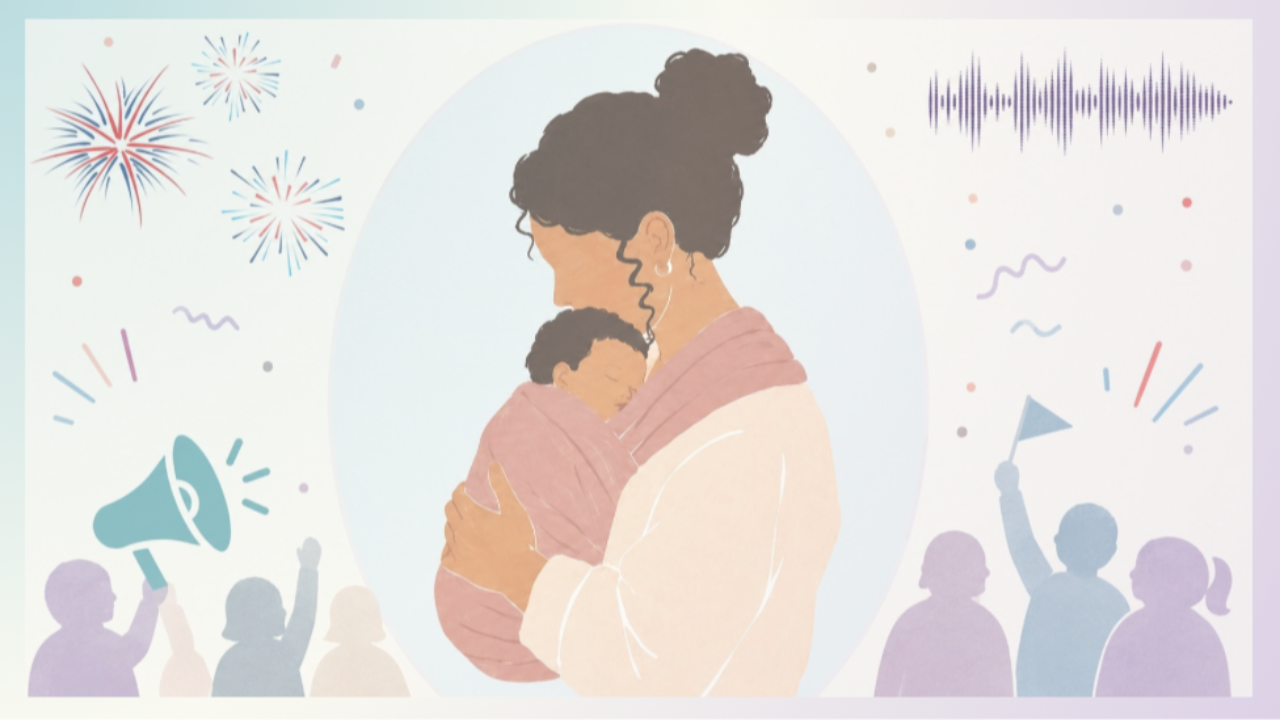
The Fourth is almost here, and somewhere this week a parent is going to stand in a crowd, watch the first of the fireworks go off, and then feel their baby go rigid against them. The flash, the crack, the crowd that gasps all at once. For a small baby and developing nervous system, it’s a lot of new sensory input arriving fast, and there’s nowhere to hide from any of it.
Here’s when the baby carrier earns its keep. As an actual tool for helping a caregiver enjoy the show and a baby get through something their body is not yet built to handle alone. And once that’s understood, the fireworks, or the baby’s reaction, stop being the problem. The same thing is true at a wedding, a New Year's countdown, a Diwali celebration, a county fair, a packed restaurant on a Friday night. Anywhere the input outpaces a baby's ability to integrate.
And sure, the baby carrier still serves as a tool for convenience while navigating the crowds, or as a way to keep a hand free for a sparkler (held far away, of course)
• • •
A small baby can’t just calm themselves
Usually, the "tips for taking baby to a party" posts skip something. Infants don't regulate their own nervous systems. The machinery isn't online yet. When a baby is overwhelmed, they don't settle by ‘deciding to settle.’ They borrow the regulation of the adult holding them.
This is co-regulation, and this isn't a ‘soft’ idea. A caregiver's steady heart rate, slow breathing, and calm body give a baby's system something to sync to, an external rhythm to organize around when their own is scrambled. The closer that calm adult is, the more available it becomes. Distance, in a moment like this, is the enemy. A baby in a stroller, down at knee or hip height in a forest of legs, has the least access to the one thing that would actually help them.
A baby on a body has the most.
• • •
What the carrier is facilitating
If we strip the moment down, several things are happening at once, none of them accidental.
There is the contact. Firm, even pressure contact across much of the baby’s body is organizing, and especially so for an overwhelmed nervous system. The holding from a well-supported carrier is different than in arm holding or even a carrier that’s loose and introduces instability. A well-built carry (or carrier) wraps a baby in steady, predictable input, and steady, predictable input is the opposite of a sky that keeps exploding and a loud group of people ooohing and awwing.
There’s rhythm. Vibrations from talking and laughter. Smells that signal safety. Body to body, a baby is nestled up with the two most regulating sounds available to them, a familiar heartbeat and the rise and fall of breath. Those rhythms don't stop when the fireworks start. They become an anchor the baby can hold onto while everything else goes sideways.
There is the sound of the explosions themselves. And no, a body, heartbeat, and breathing along with a layer of fabric will never cancel out the sounds of the fireworks, but they take the edge off the worst of it, and they do it while keeping the baby tucked against something familiar rather than exposed to the full sensory blast and managing the shock and surprise on their own.
Up at the caregiver’s level, a baby can find the caregiver's face, and a calm face is information. It tells a startled system that the adult isn't afraid, which is a message a baby reads long before they understand a single word. It’s how we teach a baby to live in the world without ever realizing we are teaching from day one. Babies are born to learn.
And don’t forget the exit. This matters more than it might sound like. Hands free and baby secured, a caregiver can be out of the crowd and into a quieter pocket of space in seconds. No pushing a stroller through crowds, or gathering bags while a meltdown builds. The ability to leave fast and easily is its own form of safety, and the carrier makes it possible.
• • •
The TDLR takeaway worth reading
Yes, the fireworks are this weekend, and the carrier is the right call for them. But the reason the baby carrier is the answer has nothing to do with the calendar. A baby meets a wall of sound, light, and motion, and the carrier places them as close as possible to the one nervous system that can help them through it, while leaving the caregiver free to read and respond in the moment, soothe, adjust, or even easily leave it.
This is true on the Fourth… just as it’s true in December, at a wedding in October, and in the restaurant next Tuesday. The sky doesn’t have to explode in a show of lights for a baby to need this. It’s simply the loudest reminder that something has always been the case.