If Babies Are the Future, Why Don’t We Design for Them?
Jul 09, 2026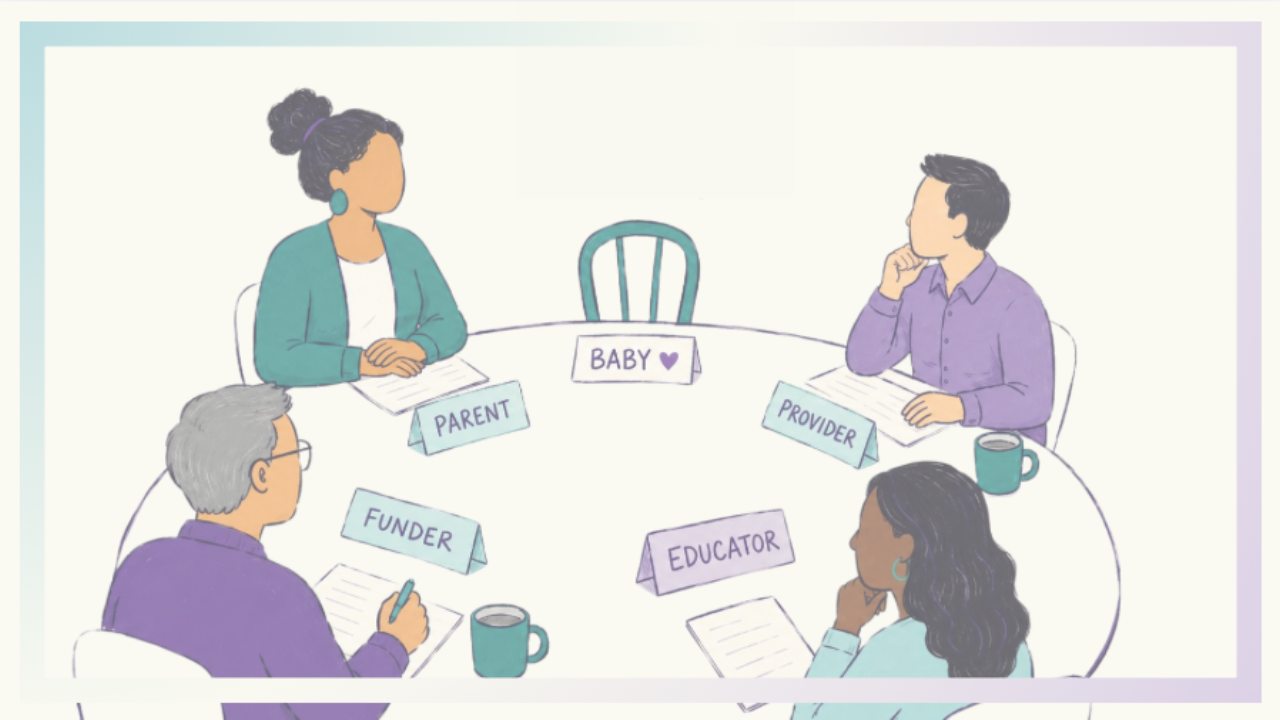
Why does this still need to be asked? We've talked about this for years already!
Unfortunately, you can see it almost anywhere…once you start looking.
A waiting room with chairs lined up for adults sitting alone, but no real place for a parent to feed a baby, sway with a fussy newborn, or fill out paperwork while holding a child who needs them.
Public spaces that never considered the families who would be there and force the caregiver to say, “Don’t walk on that,” and "Don’t touch that art.”
A public event that says families are welcome, but offers no clear place to step aside, no room to move, and no patience for a baby who behaves like a baby.
A store that technically allows strollers, but has aisles that make every turn feel like an apology. Don’t get me started on dressing rooms!
A workplace that celebrates parents in its messaging, but builds schedules, rooms, policies, and expectations around a person who arrives alone, stays uninterrupted, and isn’t needed by anyone else.
A company that says it serves families but designs products or experiences around adult convenience, efficiency, timelines, and comfort.
At some point, you have to ask what’s really being welcomed, or who?
Is it really the whole family?
This is where the old assumptions need to be shaken out.
Because most of the time, no one sat down and decided to make life harder for families. The architect didn’t draft the room thinking, “Let’s make this impossible with a baby.” The designer didn’t choose the chairs while imagining a parent bouncing a hangry infant in the corner. The company probably didn’t write the policy with a crying newborn or a curious toddler in mind at all.
And that’s the problem.
So many systems weren’t designed against families. They were designed as if families wouldn’t really be there.
They assume adults arrive alone.
They assume care can be done later.
They assume babies can wait.
They assume quiet means things are going well.
They assume a baby’s need for closeness, or a toddler’s curiosity, is something the parent should manage privately, somewhere off to the side, so everyone else can continue undisturbed.
Then when families struggle, because of course they will in these situations, the burden lands back on them.
Plan better. Bring more gear. Time the nap. Bring the stroller. Don’t bring the stroller. Wear the baby. Put the baby down. Don’t let the toddler touch that. Keep the baby quiet. Ask your kid to stop talking. Be flexible. Be on time.
And all the while, the system itself gets to stay mostly unquestioned.
That’s the part I want to linger with.
What if the parent isn’t the problem? What if the baby isn’t the disruption?
What if the real issue is that families are being asked, over and over again, to fit into spaces and systems that were never built with them in mind?
Babies are not an abstract future. They’re here now, and they need touch, movement, feeding, sleep, warmth, protection, and responsive people. They’re here now with caregivers who are trying to meet those needs while also attending appointments, buying groceries, attending classes, doing paid work, caring for older children, and trying to stay connected to the community.
That connection to community isn’t something that’s ‘nice to have’.
When spaces don’t account for babies, toddlers, and families, they don’t just feel inconvenienced. They can become more isolated. They may leave early, avoid going out, skip the event, delay the appointment, or decide it’s just easier to stay home.
Life is harder.
And this is one reason I think every person who works with families, designs, sells, teaches, or welcomes families into a space has a chance to become a baby advocate. A system changer.
A baby advocate is the person willing to ask the questions that should already be obvious, but apparently often get overlooked.
How will a caregiver with kids fit here? Where is the baby in this plan? Can a caregiver respond here without needing to leave? Are we making their day easier, or harder?
Are we treating the baby’s need to be held, fed, heard, and changed as a problem, or as something normal that should be planned for? What about the toddler? Are they a problem or someone to plan for?
Babies need to be held (fed and heard); it isn’t a bad habit. It’s a developmental expectation. You know I say this a lot.
Toddlers needing to explore isn’t a bad behavior. It’s a developmental expectation.
Sometimes this is where babywearing can become more than a helpful parenting trick. It can help a family fit into spaces that weren’t designed for them.
A carrier doesn’t fix every poorly designed space, though, and it shouldn’t be used as an excuse to ignore the bigger design questions. But it can help a caregiver and baby or toddler move through the world together. It can make it easier to leave the house, ride the bus, wait in line, attend the appointment, walk through the market, join the conversation, and stay connected to community.
The carrier is practical, yes. But the deeper value is relational.
It helps keep the baby close enough to participate in ordinary life. Close enough to hear the voices, feel the movement, notice the pauses, and learn the world from the safety of someone familiar.
It helps the toddler down-regulate, feel safe, rest, and even communicate with their caregiver.
And the research keeps pointing us back to that simple truth: closeness matters.
In the 1990 Anisfeld study, caregivers of newborns were randomly given either soft baby carriers or infant seats. The carrier group later showed greater maternal responsiveness, and by the babies’ first birthdays, more of those infants were securely attached.
Years later, Lela Rankin Williams asked a similar question with young mothers and their babies. In her study, mothers were randomly assigned to use an infant carrier for one hour a day over several months or to a comparison group focused on reading. At seven months, babies in the carrying group were more likely to show secure attachment patterns and less likely to show disorganized attachment patterns.
That doesn’t mean a carrier creates attachment all by itself. Relationships are never that simple, of course. But it does point toward something worth taking seriously. When you make closeness easier, you may make responsiveness easier too.
I’m not getting off topic here!
Just because carrying would make it easier to navigate spaces doesn’t mean that should change how we think about the spaces, products, policies, programs, and recommendations created for families. If a family space is designed only around adult efficiency, some of the adults get missed - those who are caregivers of children and babies. If a program says it serves babies but never asks what babies and their caregivers actually experience, then the baby was never really welcome in the space.
So, let’s bring the baby, and the family, back into the room! Bring them into the thinking.
Maybe the waiting room could have a wider chair and a kid-friendly area where a parent can feed while still being part of the space.
Maybe the class would openly welcome standing, swaying, nursing, bottle feeding, and stepping in and out.
Maybe the event would plan for noise, movement, and rest before the first family arrives.
Maybe the company would stop saying they are parent-friendly, and start asking how to make family life easier to support.
Maybe the public space would communicate something families don’t hear often enough.
You belong here. Your baby belongs here. Your toddler and children belong here. You don’t have to choose between being responsive and being part of the world.
Be the baby advocate in the spaces you’re already in. Ask the hard questions. Notice the assumptions. Bring a family-focused mindset to the rooms, policies, programs, products, and places you help shape.
Because babies may be the future, but they’re also here now. And the systems built around them should act like that’s true.
References:
Anisfeld, E., Casper, V., Nozyce, M., & Cunningham, N. (1990). Does infant carrying promote attachment? An experimental study of the effects of increased physical contact on the development of attachment. Child Development, 61(5), 1617–1627.
Williams, L. R., & Turner, P. R. (2020). Infant carrying as a tool to promote secure attachments in young mothers: Comparing intervention and control infants during the still-face paradigm. Infant Behavior and Development, 58, 101413.