Why Being Carried Calms Babies: The Science Behind Movement and Contact
Jul 21, 2026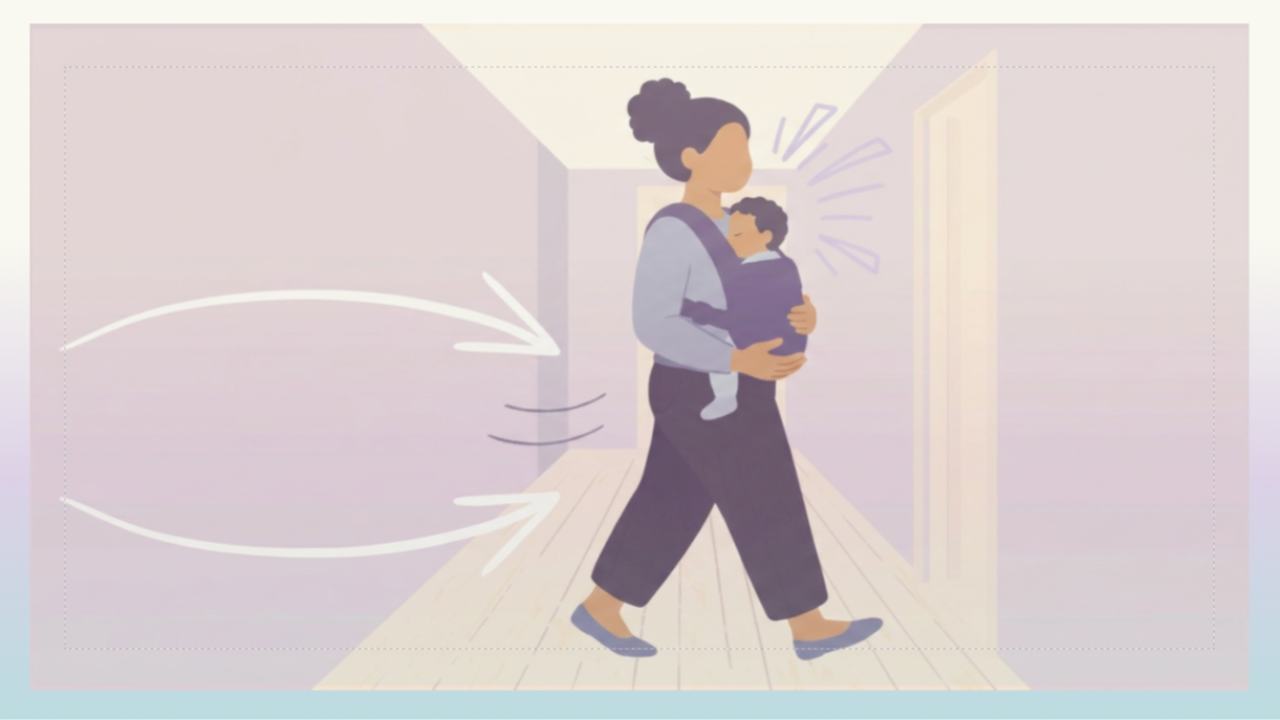
I’ve watched the same small transformation happen hundreds of times.
A baby is crying in a caregiver’s arms. The caregiver is standing, trying to adjust a carrier, listen to instructions, and soothe the baby all at once. To no avail, the baby is still crying. Then they begin to walk.
Sometimes the change is almost immediate. The baby relaxes. Their cries slow and then stop. The caregiver lets out a breath too.
Parents often experience this as a bit of everyday magic. For many years, I called it a ‘babywearing old wives' tale’ because we didn’t have official documented ‘proof.’ But we do now.
Researchers have measured what’s happening in this magical movement, and the findings offer a compelling glimpse into the biology of being carried.
A young baby isn’t simply distracted by movement. Carrying can produce a coordinated calming response that involves the baby’s heart, muscles, movement, and behavior. Contact adds warmth, pressure, rhythm, smell, voice, and the steady presence of another human body.
I think this research gives parents something many desperately need: reassurance that a baby who wants to be held hasn’t developed a problem. That baby is expressing a deeply familiar developmental expectation. Additionally, it could help many parents and caregivers to plan realistically for the postpartum if they were to learn of this expectation before the baby arrives in their arms.
• • •
What happens when a caregiver starts walking?
In a small but influential 2013 study, Esposito, G., et al. observed 12 healthy babies between 1 and 6 months old under several conditions. The babies were held by their seated mothers, carried while their mothers walked, or placed in a crib.
When the mothers began walking, the babies’ voluntary movement and crying decreased rapidly. Their heart rates also fell. The combination of these changes led the researchers to describe a coordinated infant calming response during maternal carrying.
The researchers also studied mouse pups. When the pups were transported by their mothers, they became still, vocalized less, and showed a decrease in heart rate. This similarity led the team to suggest that the transport response is a conserved part of mammalian caregiving. The response appears to help a young mammal cooperate physically while a caregiver moves them from one place to another.
A later study by Ohmura, N., et al. examined 21 caregiver-infant pairs and compared walking while holding the baby, sitting while holding the baby, placing the baby in a cot, and moving the baby in a stroller. Walking while carrying was particularly effective when babies were already crying. In that small sample, all of the crying babies stopped crying during five minutes of walking, and nearly half fell asleep. The researchers found that sitting with the sleeping baby for several minutes before attempting a transfer reduced the likelihood of the baby immediately waking. This also mirrors a long-standing recommendation of babywearing educators.
These studies were small, and they don’t establish a universal five-minute solution for crying. They do help explain why many caregivers instinctively stand up and begin pacing when a baby becomes distressed. Stationary holding provides contact. Walking adds rhythmic movement. For some crying babies, that additional movement appears to be the ingredient that shifts their physiological state.
• • •
Movement and contact arrive together - when carrying
When I talk about the biology of carrying, I don’t want to reduce the experience to one sensory system or one hormone.
A carried baby receives many forms of information or input at once:
The baby feels the caregiver’s body supporting their own. (Touch and proprioceptive input.)
They experience rhythmic acceleration and changes in direction. (Touch, proprioceptive, and vestibular input.)
They hear breathing, speech, footsteps, and the low vibrations of the caregiver’s voice. (Sound, touch, and proprioceptive input)
They feel changes in muscle tension as the caregiver stops, turns, reaches, and walks. (Touch, vestibular, muscular and connective tissue, and also proprioceptive input)
They’re surrounded by familiar smells and body warmth. (Touch, smell input, and temperature signaling input.)
Touch itself is an important form of communication, especially during early infancy. A 2025 review by Rankin, L., & Bigelow, A. E. of infant-caregiver physical contact described five broad conclusions from the previous 25 years of research: infants require touch, touch communicates, touch can be pleasurable, touch contributes to stress regulation, and interventions that increase supportive physical contact may benefit development.
Another 2025 systematic review by Naughton-Doe, R. et al. found that touch-based interventions were associated with changes in newborn physiological regulation, including lower heart rate, improved oxygenation and respiration, temperature regulation, and changes in behavioral states such as crying and sleep. Much of that evidence comes from newborn and preterm populations, so it needs to be applied thoughtfully when discussing healthy older babies.
That distinction is important. Skin-to-skin care, carrying in arms, and carrier-care, the extended holding of a baby to the body with assistance from a fabric-based device, also known as babywearing… yes, they do overlap, yet they aren’t interchangeable research conditions. A clothed baby in a carrier is likely having a different sensory experience from a premature newborn receiving skin-to-skin care in a neonatal unit.
Still, the broader infant-contact literature helps us understand why carrying can offer more than just transportation. The baby, nervous system and all, is receiving a dense stream of organized sensory information from a responsive human body.
• • •
The body is saying, “You’re with me. I have you.”
Researchers haven’t discovered a single biological message that translates neatly into the words,
“You’re safe because you’re with me. I have you. You just focus on what you need to do, now.”
• • •
That phrase is my developmental interpretation of the evidence.
Researchers can measure that a young distressed infant often becomes quieter, stiller, and physiologically calmer when held by a walking caregiver. Researchers can also examine human anatomy, infant clinging behaviors, and caregiving practices throughout our evolutionary history.
An evolutionary review published in 2020 by Berecz, B. et al proposed that carrying is a biological norm in human caregiving. The authors argued that human infants and caregivers show mutually compatible adaptations for close transport, shaped over a very long period of human development. Human babies are born highly dependent. They can’t follow a caregiver, find shelter, reliably regulate their body temperature, or move themselves away from danger. Proximity gives them access to the person who can respond to all of those needs.
From that perspective, movement with a caregiver can provide a powerful cluster of reassuring information:
My body is supported.
My familiar person is here.
We’re moving together.
I haven’t been left alone.
That doesn’t mean every baby experiences a crib, stroller, bouncer, or separate room as dangerous. Babies can be peaceful and content in many places. Temperament, age, health, hunger, fatigue, sensory preferences, and familiarity all influence how an individual baby responds. And humans are incredibly resilient and capable of living in many environments.
The more supportable conclusion is that putting a baby down removes some of the sensory and relational information that can help them regulate. A calm baby may tolerate that change easily. A tired, hungry, uncomfortable, or distressed baby may protest the loss of contact immediately.
• • •
A calming response isn’t the same as emotional shutdown
I sometimes hear the transport response described as though infant carrying switches off crying.
That language can lead us in an unhelpful direction. Crying is a form of communication, and a quiet baby hasn’t necessarily had every need resolved.
A baby may become quieter while being carried and still need feeding, a diaper change, medical attention, less stimulation, more sleep, or time to recover from an overwhelming experience. A baby can also remain upset while being held. Carrying doesn’t override pain, illness, hunger, reflux, sensory distress, or every individual preference.
The transport response describes a shift in state. It gives the baby’s body support while the caregiver continues to observe, interpret, and respond.
I find that distinction especially valuable for educators. The goal of babywearing education shouldn’t be to teach parents how to make babies stop expressing themselves. I want to help a caregiver create conditions in which the baby has a better chance of settling while the caregiver remains curious about what the baby is communicating.
Sometimes carrying is the response the baby needed. Sometimes it creates enough calm for the caregiver to work out what comes next.
• • •
Wanting to be held is a developmental expectation
Parents are still warned that responding too often will “spoil” a baby or create a habit that will become impossible to change.
The carrying research doesn’t support that fear.
There’s also some evidence connecting carrying with aspects of the developing parent-infant relationship. In a small 1990 randomized study by Anisfeld et al., families received either a soft infant carrier or an infant seat. At 13 months, secure attachment was more common in the carrier group. A later study by Williams et al., involving adolescent mothers, also found more secure and less disorganized attachment behavior among infants in a carrier intervention. These studies are promising, although the samples were small and the overall babywearing evidence remains limited.
A 2023 scoping review by Grisham, L. M., et al. identified 29 studies on the biological and behavioral effects of babywearing. The review found research suggesting possible benefits related to contact, responsiveness, attachment, crying, physiology, caregiver empowerment, and communication. The authors were equally clear that the evidence base remains too small and too varied to support sweeping practice recommendations.
More recently, a 2024 study by Firk, C., & Großheinrich, N. found that parents who reported higher levels of infant carrying also reported fewer bonding difficulties, more curiosity about their babies’ inner experiences, less frustration in response to crying, and fewer insensitive calming behaviors. Because this was an association study, it can’t tell us whether carrying produced those differences. Parents who are already more comfortable with closeness may also choose to carry more.
I wouldn’t promise parents that using a carrier will create secure attachment. Attachment develops through countless interactions over time and is influenced by the caregiver, the baby, family circumstances, health, stress, support, and culture.
I would confidently tell a parent that responding to a young baby’s wish for contact doesn’t need to be treated as the beginning of a bad habit. And there just might be some upsides.
• • •
Carrying can support the caregiver’s regulation too
The conversation about calming babies often ends with the baby. I think we need to keep the caregiver in view.
Holding a baby in arms for long periods can be physically exhausting. It can limit eating, preparing food, caring for another child, traveling, or simply stepping outside. A well-worn carrier can make sustained contact more manageable for some bodies and families.
There’s emerging evidence that this may affect caregiver well-being.
In a 2023 randomized trial by Little, E. E. et al., 100 pregnant participants from a low-income community were assigned either to receive an ergonomic infant carrier with instruction or to a waitlist group. At six weeks postpartum, participants in the carrier group reported fewer symptoms on the Edinburgh Postnatal Depression Scale. The study was relatively small, and the researchers called for larger trials before infant carriers are treated as a mental-health intervention.
A separate randomized feasibility trial by Wigglesworth, H. et al. provided new mothers with a carrier, training, support, and carrier hire. The study wasn’t large enough to determine whether the intervention reduced postnatal depression. It found a significant improvement in maternal self-efficacy, and participants described greater autonomy, bonding, confidence, and freedom to move through daily life.
That word, autonomy, deserves attention.
For a parent who has spent days sitting on a couch because the baby cries whenever they’re put down, a carrier may make it possible to prepare lunch, walk around the block, take public transportation, visit a friend, or attend a parent group. Those actions don’t guarantee better mental health. They can restore choices that had begun to disappear.
Perinatal loneliness is associated with poorer mental health, including postnatal depression. A 2025 review by Naughton-Doe, R. et al. found that promising approaches to loneliness often involved opportunities for meaningful social contact, relationships with supportive professionals or volunteers, normalization of difficult experiences, shared activities, and practical help overcoming financial or cultural barriers to participation.
A carrier can sometimes help a parent reach those points of connection. Hear me when I say, it can’t create affordable childcare, accessible transportation, paid leave, nearby family support, safe sidewalks, welcoming bathrooms, or public spaces designed for babies and caregivers. Families need all of that.
• • •
I don’t want babywearing to become the personal solution offered in place of structural support.
Families need both practical tools and communities that expect, want, and plan for their participation. Public spaces, workplaces, healthcare settings, transit systems, and neighborhood organizations should be designed with babies and caregivers in mind. A parent shouldn’t have to become exceptionally skilled at managing on their own before they’re allowed to rejoin public life. But I digress; read this post if you’re curious.
• • •
Some babies and caregivers need different options
Not every baby settles in a carrier. Not every caregiver enjoys close physical contact. Pain, disability, birth recovery, surgical wounds, pelvic-floor symptoms, sensory differences, trauma histories, body shape, infant medical needs, and carrier design can all influence the experience.
A baby who cries in a carrier hasn’t failed at babywearing.
A parent who needs space from touch hasn’t failed at responsive care.
Contact-rich care can include carrying in arms, lying together while awake, skin-to-skin time, feeding, rocking, massage, singing, shared floor time, or another caregiver taking a turn. Babywearing is one way to make contact possible during movement. Families need options rather than a new standard they’re expected to meet perfectly.
• • •
What I want parents to know
As an educator, I want to share :
Some babies need movement before they can organize themselves enough to settle into the carrier.
Your baby’s wish to be held makes sense.
Your baby has arrived, but there is still a lot of development to come, and with immature nervous and sensory systems that lead to a strong orientation toward human proximity. Contact provides your baby with warmth, touch, movement, sound, smell, protection, and a responsive person. Walking while carrying can produce measurable changes in crying, movement, and heart rate, particularly when a young baby is already distressed.
You’re also allowed to need your hands, your mobility, your community, and moments when someone else carries the baby.
A carrier can help some families hold those needs together. It can allow a baby to remain connected while the caregiver moves through ordinary life. It can help another parent, grandparent, relative, or trusted caregiver become part of the baby’s circle of regulation.
When your baby is crying, you might try bringing them close and walking at a steady pace. If they fall asleep and you plan to transfer them, pausing with them for a few minutes before putting them down may also help. This can sit alongside feeding, changing, reducing stimulation, checking for discomfort, seeking medical advice when needed, and simply remaining present through a difficult period.
You don’t have to teach a newborn that their signals won’t always bring someone near.
Every time your baby experiences distress followed by responsive care, they gain another experience of moving from discomfort toward regulation in the company of another person. Over time, those experiences become part of how regulation develops.
• • •
The carrier is a tool.
The contact is the practice.
The deeper resource is the relationship,
supported by a family and community
that recognize babies as participants in everyday human life.
Happy holding!
• • •
References
Berecz, B., Cyrille, M., Casselbrant, U., Oleksak, S., & Norholt, H. (2020). “Carrying Human Infants: An Evolutionary Heritage.” Infant Behavior and Development.
Esposito, G., et al. (2013). “Infant Calming Responses during Maternal Carrying in Humans and Mice.” Current Biology, 23(9), 739–745. DOI: 10.1016/j.cub.2013.03.041.
Firk, C., & Großheinrich, N. (2024). “Infant Carrying: Associations with Parental Reflective Functioning, Parental Bonding and Parental Responses to Infant Crying.” Infant Mental Health Journal. DOI: 10.1002/imhj.22106.
Grisham, L. M., Rankin, L., Maurer, J. A., Gephart, S. M., & Bell, A. F. (2023). “Scoping Review of Biological and Behavioral Effects of Babywearing on Mothers and Infants.” Journal of Obstetric, Gynecologic & Neonatal Nursing, 52(3), 191–201. DOI: 10.1016/j.jogn.2022.12.008.
Little, E. E., Bain, L., & Hahn-Holbrook, J. (2023). “Randomized Controlled Trial to Prevent Postpartum Depressive Symptomatology: An Infant Carrier Intervention.” Journal of Affective Disorders, 340, 871–876. DOI: 10.1016/j.jad.2023.08.044.
Naughton-Doe, R., et al. (2025). “Interventions That Prevent or Reduce Perinatal Loneliness and Its Proximal Determinants: A Restricted Scoping Review.” BMC Public Health, 25, 495. DOI: 10.1186/s12889-024-20788-z.
Ohmura, N., et al. (2022). “A Method to Soothe and Promote Sleep in Crying Infants Utilizing the Transport Response.” Current Biology.
Norholt, H., & Phillips, R. (2022). Babywearing Practices and Effects on Parental and Child Physical and Psychological Health. Academic Journal of Pediatrics & Neonatology. https://doi.org/10.19080/AJPN.2022.11.555876 (linkhttps://juniperpublishers.com/ajpn/AJPN.MS.ID.555876.php)
Rankin, L., & Bigelow, A. E. (2025). “Know When to Hold ’Em: How Does Early Infant-Caregiver Physical Contact Impact Infant Behavior and Development?” Infant Behavior and Development, 80, 102081. DOI: 10.1016/j.infbeh.2025.102081.
Wigglesworth, H., Huddy, V., Knowles, R., & Millings, A. (2023). “Evaluating the Impact of Sling Provision and Training upon Maternal Mental Health, Wellbeing and Parenting: A Randomised Feasibility Trial.” PLOS ONE, 18(11), e0293501. DOI: 10.1371/journal.pone.0293501.