It’s Just a Ring. Or Is It?
Oct 12, 2026
There's one thing that's ALWAYS in my bag, whether I'm consulting, teaching, traveling, or otherwise: a pair of SlingRings.
Why, you ask?
Ummm, isn't it obvious? They're useful for SO many things!
Babywearing, of course, but I've also used them to make a belt, fix a broken purse strap, hang extra things on my backpack, create an instant privacy screen, and even give a little structure to a shirt that needed some help. I've worn them as bracelets, too.
And I'm quite sure that isn't the complete list, lol.
While I was in Arizona recently, I had the chance to catch up with several CBWS graduates and spend time with people I've known in the babywearing industry for years.
One of those people was Rochelle, the owner of SlingRings.
Rochelle and I have known each other for about 16 years now. We've shared booth space, hotel rooms, conversations about our families and businesses, and watched our kids grow up.
We were joined for coffee by Taylor of Registry with Taylor and Hailey, the Babywearing NICU Nurse. Between discussions about research, hospital babywearing programs, expecting parents, and the differences between American and European carrier standards, the time disappeared.
And, of course, we talked about rings.
More specifically, we talked about who's using SlingRings these days, where other brands might be sourcing theirs, and how much we really know about the components going into the carriers we recommend.
Then, when I climbed into Rochelle's car to head to dinner, look what was casually sitting in the back!
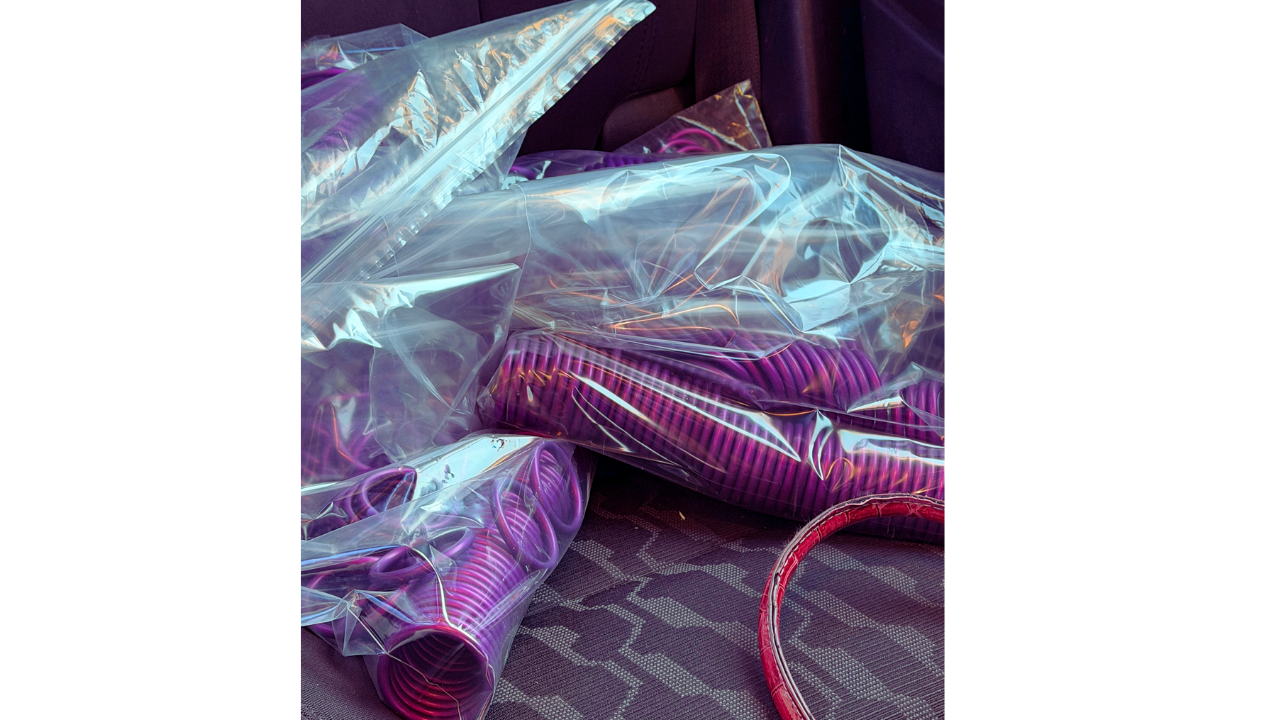
PURPLE!
You know I wanted to tear open that package and play with them.
But those pretty purple rings got me thinking about something much more important.
•••
I've watched this industry grow up
There's something rather lovely about sitting down with someone you've known for 16 years and realizing just how much has changed.
Rochelle and I have watched each other's children grow up, our businesses evolve, and the babywearing industry become something much bigger than it was when we first met.
We've seen trends come and go, new brands arrive, familiar brands disappear, and the conversations around safety and standards become increasingly sophisticated.
We've also been around long enough to know that progress doesn't happen automatically.
It happens because people notice problems, ask questions, push for better practices, and refuse to accept that the way something has always been done is necessarily the best way.
And sometimes, sitting in a car looking at a bag of beautiful purple rings, I'm reminded of just how much there is behind one seemingly simple piece of hardware.
•••
A ring is not just a ring
When you look at a ring sling, the rings might seem like a relatively simple piece of hardware.
Two smooth circles of metal, holding fabric in place.
But think about what they're actually responsible for.
They form part of the mechanism that supports a baby's weight. They need to withstand repeated loading, adjustment, and everyday use without bending, breaking, or allowing the fabric to slip unexpectedly.
And the person using that carrier needs to be able to trust them.
That's why I care so much about how those rings are made, tested, and tracked.
Because there is a history here that I don't want us to forget.
In March 2008, the Consumer Product Safety Commission announced the recall of approximately 1,200 Ellaroo ring slings because their aluminum rings could bend or break, potentially allowing the fabric to slip and an infant to fall.
The company had received four reports of bending and two reports of breakage. Thankfully, no injuries were reported.
You can read the original CPSC recall here.
This actually happened.
And here's something worth remembering: it was another decade before the first mandatory federal safety standard for sling carriers took effect in 2018.
We've come a long way since then.
Today, US sling carriers are subject to 16 CFR Part 1228, which incorporates ASTM's sling-carrier safety specification, including requirements addressing structural integrity and occupant retention.
Those changes are important.
But standards and regulations don't eliminate the possibility of manufacturing defects, supplier problems, or failures in quality control.
We should assume that failures remain possible and build our expectations around preventing them, identifying problems early, and responding quickly if something does go wrong.
•••
And then there's the pretty color
Let's go back to those purple rings for a moment.
Have you ever wondered how a metal ring becomes purple? Or blue? Or red?
Many aluminum sling rings are anodized, a process that changes the surface of the metal through an electrochemical reaction. The resulting oxide layer is integrated with the aluminum itself. Color can then be introduced through different methods, including dyes.
It's rather fascinating, actually. And it's different from simply applying paint to the surface. But knowing a ring is anodized doesn't tell you everything about its composition or the substances used for coloring and finishing.
What was used to create that beautiful purple? What remains in/on the finished ring? And what testing was done to verify the chemical safety of that finished product?
Those are questions worth asking.
Especially because we're talking about babies!
A baby's body is smaller than ours, and their developing organs and systems can respond differently to chemical exposure. For some substances and exposure routes, a relatively small amount can represent a more significant dose in relation to body weight.
And babies explore their world through touch and through their mouths. You've probably seen a baby reach for the rings on a carrier, grab at them, or try to mouth them. That makes understanding the materials and finishes especially important. A carrier component isn't automatically a tested teether simply because a baby can reach it.
I'm certainly not suggesting that those lovely purple rings are dangerous because they're colorful.
But I do want manufacturers to know what materials are being used, how they've been evaluated, and what those test results actually establish.
And I want the people making the finished carriers to be able to verify that information.
•••
Tested? Great. But what does that actually mean?
One thing I appreciate about SlingRings is that the company publishes information about its testing practices.
According to its website, the company pull-tests each individual ring to 250 pounds.
It also reports that it pulls one ring from each manufacturing batch to destruction, and periodically sends additional samples for independent crush and deformation testing, as well as chemical testing. (Gold Standard.)
You can read SlingRings' published testing information here.
Now, individual ring testing and destructive batch testing are different things. The strength of an individual ring is different from the strength of a completed carrier. It's entirely possible to have a very strong ring sewn into a carrier with a problem elsewhere in its design or construction.
Which is why finished-product testing is also essential.
But component testing can provide another layer of quality control. It can help identify problems before those components ever become part of a carrier.
And this is where I'd like to see our industry have more conversations.
Because when a manufacturer tells me that its rings are tested, my next question is going to be:
“How? And how often?”
“Were they tested once when the product was developed?”
“Is a sample tested from each production batch?”
“Is every ring tested?”
“Are tests repeated when a supplier, material, or process changes?”
“And who is doing the testing?”
These are very different quality-control approaches, and understanding them helps us evaluate the assurances we're being given.
•••
Can you trace those rings?
Here's another question. (I guess I’m full of them today.)
Imagine that a problem is discovered with a particular batch of rings. Can the supplier identify the affected batch?
Can the carrier manufacturer identify which carriers received those rings?
Can those carriers be traced to their production dates and, if necessary, to the businesses or customers who received them?
That's traceability.
US children's products already have tracking-label requirements intended to help identify products and their manufacturing history. Those requirements make recalls and other safety responses more effective.
But I also want manufacturers to think about the traceability of the critical components going into those products.
A batch of rings might be used in hundreds or thousands of carriers.
And a carrier company might use different ring suppliers over time. Good records can help identify which finished products contain which components. If a problem is discovered, the difference between having that information and not having it could be enormous.
•••
So, what should we be asking?
When we're looking at rings used in baby carriers, I think we should be able to ask some straightforward questions.
Where were the rings manufactured, and by whom?
What materials were used, and how were the rings made?
How were they colored or finished?
What testing was completed to evaluate their strength and chemical safety?
Are individual rings tested? Is each batch sampled?
Can a ring batch be traced through the manufacturing process to the finished carrier and then to the consumer?
What happens when a supplier changes?
And how does the carrier manufacturer independently verify the information it receives?
That last question is particularly important.
If a ring supplier says its products are tested, what documentation has the carrier manufacturer actually reviewed? Are there reports from independent laboratories? What was tested, under which standards, and when? Do those reports correspond to the materials, finishes, and production batches currently being used?
And does the manufacturer have an established process for making sure that changes don't go unnoticed?
The CPSC's own guidance on component-part testing makes clear that manufacturers relying on supplier testing have a responsibility to exercise due care and obtain the necessary supporting documentation.
In other words, accepting a supplier's assurance without understanding the evidence behind it isn't a particularly good approach.
•••
“Trust but Verify. Good in Life and Business.”
This isn't about being difficult, though.
I've spent much of my professional life watching the babywearing community and industry evolve, teaching others, and trying to improve how we understand and support infant carrying.
And I've seen some remarkable people and companies doing thoughtful work along the way.
I want that work to continue. But I also know that people rely on us. When you recommend a carrier to a parent, you're sharing more than your opinion about whether it's comfortable or easy to use.
You're sharing some of your professional judgment.
And that judgment relies, in part, on the work of the people making the product. It's a chain of trust, really. From the supplier who manufactures the ring, to the person making the carrier, to the educator recommending it, and ultimately to the family using it.
The family at the end of that chain may never know who manufactured the rings or how they were tested.
But someone should.
And as professionals who work with those families, I think it's reasonable for us to ask.
I don't expect perfection. Manufacturing failures can happen, even when people are taking considerable care. What I do expect is thoughtful manufacturing, meaningful testing, good recordkeeping, and a willingness to answer questions.
We've learned some hard lessons in the babywearing industry over the years.
I'd rather we put that knowledge to work today than wait for another failure to remind us why we learned those lessons in the first place.
And while I've used rings as the example here, the conversation applies just as readily to buckles, webbing, stitching, fasteners, and all the other component parts that make up a carrier.
A component may be small, inexpensive, or almost invisible to the person using the product. That doesn't make it unimportant.
•••
Listen, I love a beautiful carrier. I love thoughtful design, innovative products, and yes, I absolutely love a gorgeous pair of purple rings.
But I've been doing this long enough to know that the parts you don't think about are often the ones you really need to understand. We've spent years working toward better standards, stronger research, and more informed conversations around infant carrying.
I'd like us to keep moving forward.
And sometimes that means asking manufacturers questions they may not be accustomed to hearing. That's okay.
I'd much rather be the person asking an uncomfortable question today than the person wondering, after something goes wrong, why nobody asked it sooner.
•••
Sources and further reading
CPSC: Ellaroo Ring Sling Recall, March 2008
CPSC: Sling Carrier Safety Requirements
CPSC: Component Part Testing and Supplier Verification
CPSC: Tracking Labels and Product Traceability
CPSC: Lead in Paint and Surface Coatings
US EPA: Children's Unique Vulnerabilities to Environmental Hazards